The moving cost from the Netherlands to Germany for a full household sits between 2,700 and 3,800 euros according to Dutch comparison platform Sirelo (2026), while Verhuisoffertes.com lists 1,500 to 4,000 euros. Where you land inside that band depends on your volume in cubic metres, the distance to your German city, access at both doors, whether the crew packs, storage and the season. A fixed quote after a survey is the only number you can plan with.
How much does a move from the Netherlands to Germany cost?

A move from the Netherlands to Germany costs 2,700 to 3,800 euros for a full household on Sirelo’s 2026 list, and 1,500 to 4,000 euros on Verhuisoffertes.com. Both are Dutch comparison platforms, and both bands describe a professional mover with a lorry and crew, with no customs inside the EU.
The ranges differ because the platforms count different moves: a one-room flat to the Ruhr in a quiet month at the bottom, a family house to Berlin with packing at the top. This guide gives no price for The Easy Move, because none of those figures are known before a survey, whichever phrase you searched: the cost of moving to Germany from the Netherlands or, as German readers do, Umzug Niederlande Kosten. For every destination, read how much an international move from the Netherlands costs.
How is the price of a move to Germany built up?
The price of a move to Germany is built from four parts. Dutch moving site Verhuizenkunjezelf.nl describes the split as roughly 40% transport, 25% loading, 25% unloading and 10% extras. Transport is the lorry, the driver, fuel and road charges; loading and unloading are crew hours at each address, stairs included; extras cover boxes and wrapping, a furniture lift, a parking permit and storage.
Two German items sit inside those parts. The first is the Lkw-Maut: according to the ADAC, Germany has charged a toll on Autobahnen and Bundesstraßen since 1 July 2024 for commercial vehicles over 3.5 tonnes, so a full-size removal lorry pays Toll Collect per kilometre. The second is the Halteverbotszone, the no-parking zone a German city requires before a lorry may block a street. Stadt Köln asks for the application three weeks ahead and charges 36 euros for the first day and 18 for each further day; Stuttgart asks for two weeks and quotes usually 30 to 100 euros. Fees change, so check the current rules with the Straßenverkehrsbehörde of your new city.
How much does the distance to your German city matter?

Distance sets the transport share, the largest of the four parts, so the city you move to moves the price more than anything except volume. The lorry crosses at Venlo onto the A40, or runs past Aachen for Cologne and the south.
| Destination | Distance from Eindhoven | Typical driving |
|---|---|---|
| Düsseldorf | about 110 km | about 1.5 hours |
| Cologne | about 145 km | about 1.75 hours |
| Frankfurt am Main | about 340 km | about 3.75 hours |
| Berlin | about 650 km | about 6.5 hours |
| Munich | about 725 km | about 7.5 hours |
Distances are route-planner figures from central Eindhoven. Düsseldorf and Cologne are day trips: one day of lorry and crew. Berlin and Munich mean an overnight stop, a second day of driver time and six to seven hundred kilometres of Maut; NOBL Relocation, a Delft mover, adds a day for both. The German paperwork is covered on the page about moving from the Netherlands to Germany.
How does your volume in cubic metres set the price?
Volume in cubic metres is the single largest driver of a quote to Germany, because it decides the size of the lorry, the number of crew and the hours at both doors. Movers price in cubic metres, not in rooms: a sparsely furnished house can load smaller than a two-bedroom flat with a full cellar.
An online form works for a studio or a single room, the kind of job the small move service handles; a video survey is accurate for most households; a home visit is still best for a large house or awkward access. Show the attic and the shed, because they are the usual reason a lorry turns out too small. The cheapest cubic metre is the one you do not move: furniture that will not fit a German flat is cheaper to sell in the Netherlands than to transport and discard in Germany.
Is groupage cheaper than a dedicated vehicle to Germany?
Groupage is cheaper than a dedicated vehicle for a small volume, because your goods share a lorry with other households and you pay for your share of the space. A dedicated vehicle carries only your household and usually delivers within one to three days inside Western Europe; groupage runs to the carrier’s schedule, typically one to three weeks.
Düsseldorf and Cologne sit close enough to Eindhoven that a dedicated van for a one-bedroom flat costs little more than a groupage slot. For a studio to Berlin or Munich, groupage usually wins, provided the keys are not tied to a single day. VANonsite’s cost guide puts it well: a half-full van is not half the price of a full one, because the driver, the fuel and the Maut cost the same whatever is in the back.
What do access, the packing option, storage, insurance and the date add?
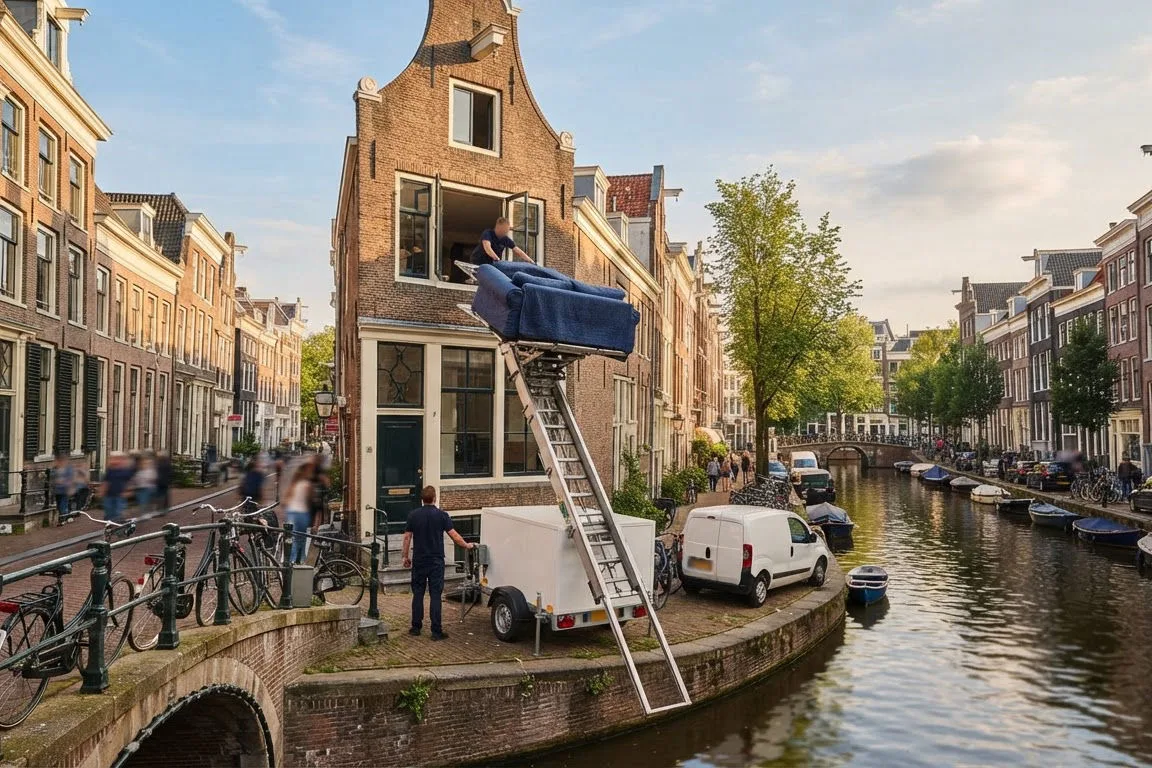
Access, packing, storage, insurance and timing make up the extras and part of the crew hours, and together they can outweigh distance. A fourth-floor Altbau flat in Berlin without a lift adds crew hours or a furniture lift; the moving lift with a trained operator is often cheaper than carrying a wardrobe down four flights.
Full packing by the crew costs hours and materials; packing yourself saves those hours. Storage comes into play when the German keys come later than the Dutch handover: Sirelo lists storage at 75 to 140 euros a month, and climate-controlled storage in the south of the Netherlands bridges the gap. Insurance is priced on the value you declare. Sirelo puts car transport within Europe at 500 to 1,500 euros. Timing is the one you control: month-end, summer and the weeks around Christmas book out first.
What costs wait on the German side after arrival?
The German side adds four costs that no removal quote includes. Under § 551 of the Bürgerliches Gesetzbuch, the Mietkaution, the rental deposit, may be at most three times the monthly rent excluding operating costs, payable in three monthly instalments. The Rundfunkbeitrag is the broadcasting fee, paid per Wohnung: the Verbraucherzentrale puts it at 18,36 euros a month, and one adult registers the flat with the Beitragsservice. Check the current rules with the Beitragsservice, because the amount changes.
Your car must be re-registered at the Kfz-Zulassungsstelle once you are resident. The Europäisches Verbraucherzentrum Deutschland lists what the office asks for: the Dutch vehicle papers, an eVB insurance confirmation, the COC certificate, a valid Hauptuntersuchung for a car older than three years and a SEPA mandate for the Kfz-Steuer. The fourth is health insurance, compulsory according to Make it in Germany, the Federal Government’s portal, statutory or private, paid from income. On the Dutch side, your basic health insurance ends when you deregister from the BRP, and the Belastingdienst expects an M-form for the year you leave.
What does The Easy Move do on a move to Germany?
The Easy Move is an international moving company based in Eindhoven, close to the German border, and it moves households and businesses on the Netherlands to Germany route. We call ourselves the friendliest movers in Europe, with around 150 Google reviews and a damage-free guarantee. The quote is free and without obligation, and after a consultation it is fixed, with no hidden fees.
On a German move the international moving service covers the survey, packing, disassembly and assembly, transport by dedicated vehicle or groupage, the moving lift, delivery, storage and insurance options. Start with the Easy Quote form and name the German city, the floor and whether the street needs a Halteverbotszone, because those three details decide most of the price.
Frequently asked questions
Why does the cost of moving to Germany vary so much?
Because the two largest parts of the price, transport and crew hours, both scale with facts that differ per household: 110 km to Düsseldorf against 725 km to Munich, 15 cubic metres against 50, a ground floor against a fourth floor without a lift. Add packing and the season, and two households sit at opposite ends of Sirelo’s band.
Are public price examples fixed quotes?
No. The Sirelo and Verhuisoffertes.com ranges are averages of quotes other people requested, and a route example on a mover’s website is an illustration, not an offer. A fixed quote exists only after a survey; The Easy Move fixes its price after a consultation.
What usually makes a quote rise unexpectedly?
Volume not shown at the survey, such as a full attic or shed, is the most common cause. The others are access worse than described, a street that needs a Halteverbotszone nobody applied for, and keys that arrive later than the lorry. An honest survey and a confirmed handover date avoid all four.
Is moving to Germany cheaper with a man and van?
For a single room or a few pieces of furniture to Düsseldorf or Cologne, a small van with one driver is usually cheapest, and a van under 3.5 tonnes pays no Lkw-Maut. For a full household the saving disappears: a van makes several trips and one driver cannot carry wardrobes.
How long do removals to Germany from the Netherlands take?
A dedicated vehicle usually delivers within one to three days inside Western Europe, and Düsseldorf or Cologne can be done in a day. Groupage runs to the carrier’s schedule, typically one to three weeks. Lead time matters more: book the mover and the Halteverbotszone three weeks ahead.