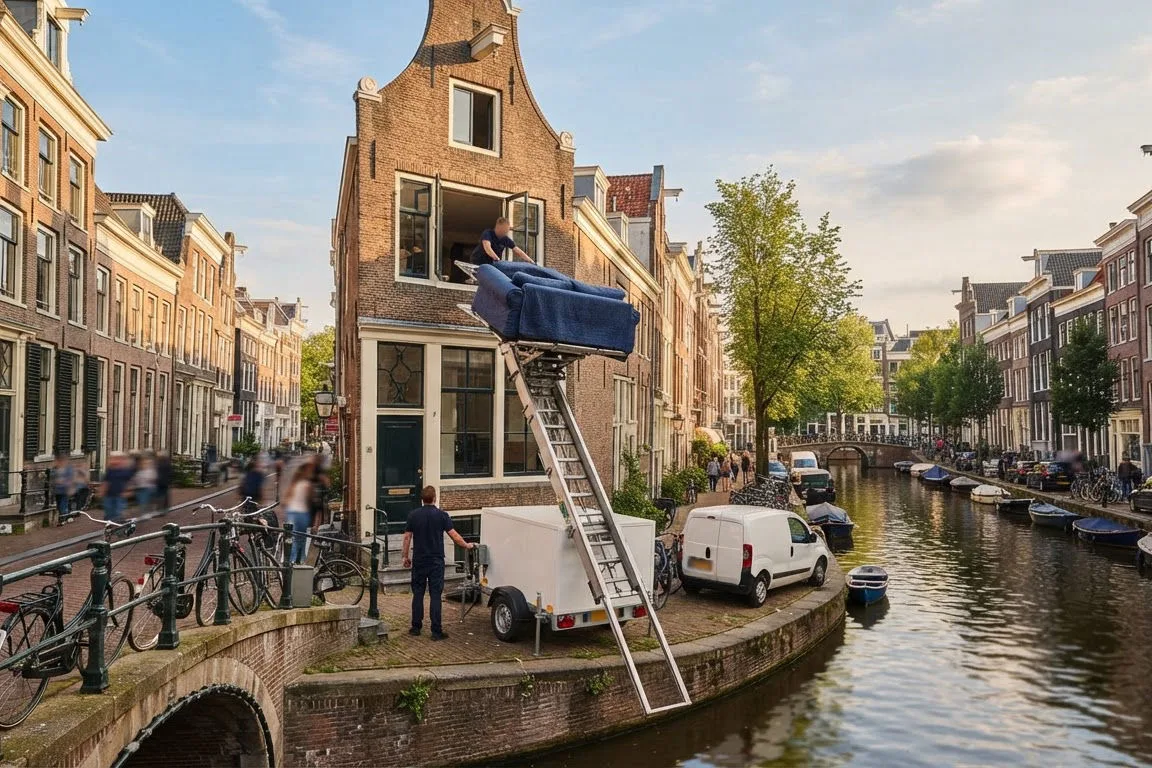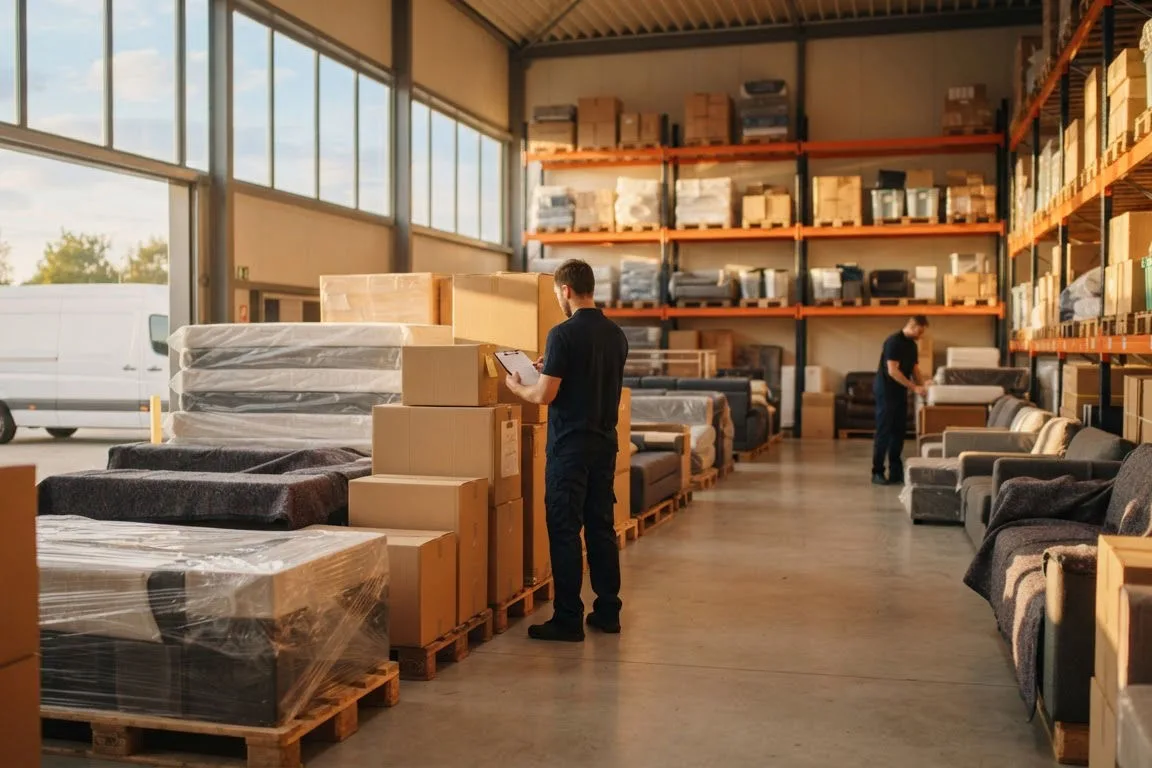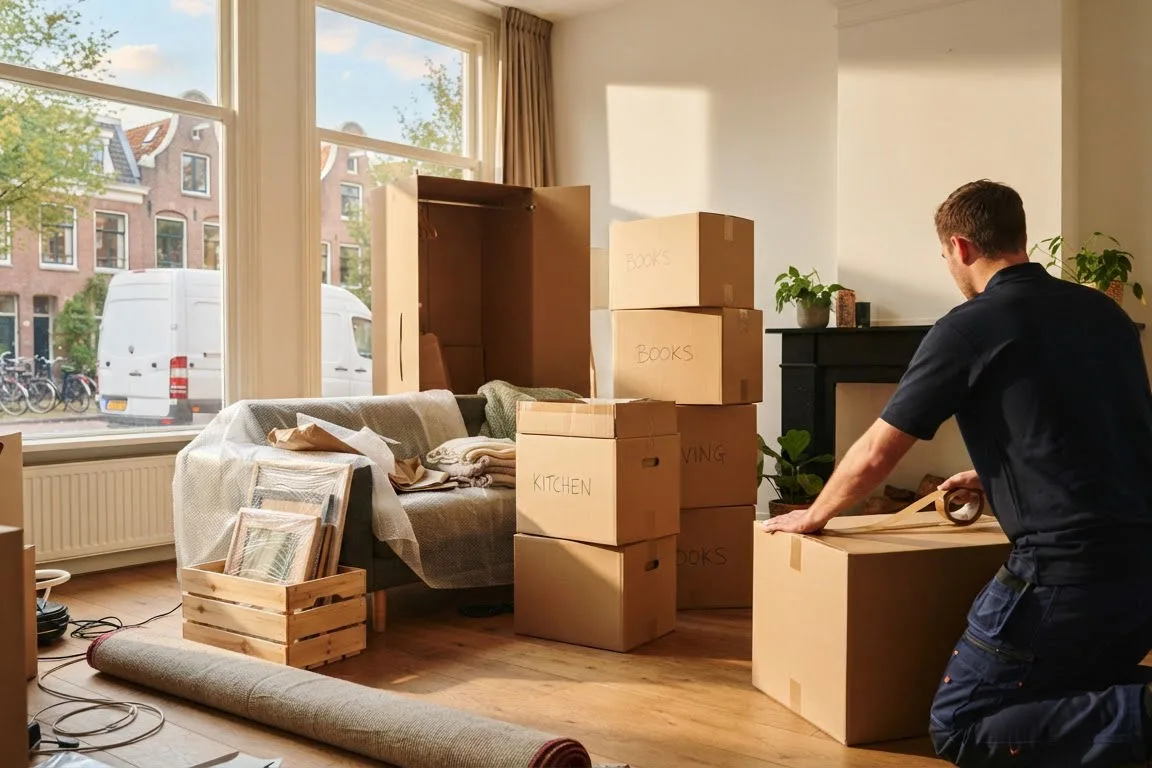
Packing for an international move by road from the Netherlands differs from a local move in three ways: boxes must survive a longer, rougher trip, so you use double-walled cartons and crates for anything fragile; for a destination outside the EU (the UK or Switzerland) every box must match a customs inventory; and a list of goods stays out of the lorry altogether, from gas bottles and paint to plants, perishables, passports and the cat.
Which boxes and materials do you need for a cross-border move?

Double-walled cartons are the standard international moving boxes, because a 600 km trip with a stop at a border office means more knocks than a move across town. Use standard sizes that stack: Windmill Forwarding, a Dutch forwarder, notes that uniform cartons save lorry space and that a box should weigh no more than about 20 kg.
Wardrobe boxes have a rail, so suits and dresses travel hanging. Dish packs with cell dividers hold plates upright and glasses on their side. Picture boxes or wooden crates carry framed art, mirrors, glass table tops and televisions; Moving Tips and Sirelo both advise crates for art and pianos. Add packing paper, bubble wrap, good tape and labels. If the house is large, the packing and unpacking service brings the materials and packs the fragile rooms in a day.
In which order should you pack the house?
Pack from the rooms you use least to the rooms you use most, and begin two to three weeks before loading. The garage, shed and attic go first, because they hold the items movers refuse. Books, out-of-season clothes and the guest room follow. The kitchen and bathroom are last, the night before, and one box of first-night items stays open until the crew arrives.
Sort as you go. Furniture that will not fit a Paris flat or a Zurich stairwell and appliances on the wrong plug are cheaper to sell or donate in the Netherlands than to transport and discard abroad; Sirelo puts large, low-value furniture at the top of the leave-behind list. Anything you cannot place yet goes into storage in the south of the Netherlands rather than into the lorry. The international moving checklist puts the Dutch deregistration and the customs file on the same calendar as the packing.
How do you label boxes for a customs inventory?

Labelling depends on one question: is the destination in the EU? Inside the EU, Dutch Customs states that you do not need to file a customs declaration for removal goods, so a number, the room and a word about the contents on each box is enough. Outside the EU, the same label must match a line on a customs inventory.
| Destination | Customs paper | The list |
|---|---|---|
| Germany, Belgium, France, Spain, Italy | None inside the EU (Dutch Customs) | Your own box list |
| United Kingdom | ToR1 to HMRC before the goods ship | Groups such as books need no item names, quantities may be estimated (GOV.UK) |
| Switzerland | Form 18.44 at the border office | List of relocation goods, used at least six months (BAZG) |
| Into the Netherlands from outside the EU | Relief filed by the removal company | Signed inventory, goods owned and used at least six months (Dutch Customs) |
Number every box and repeat the number on the inventory, so an officer who opens box 23 finds “kitchen, pans and cutlery, approximately 40 pieces”. Keep alcohol and tobacco off the relief list, since GOV.UK and Dutch Customs both exclude them, and a television bought last month fails the six-months-owned rule. Forms change, so check the current rules with HMRC, the BAZG or Dutch Customs first.
What will movers not take on a cross-border move?
What not to pack when moving abroad starts with dangerous goods: movers will not load them, and under the Dutch general conditions for removals (AVVV 2015, published by the SER) they do not have to, because article 10 lets an Erkende Verhuizer refuse dangerous goods it was not told about, or unload and destroy them at the customer’s cost. Bournes, a UK international mover, lists what that means: gas bottles, aerosols, paint, fuel, ammunition and batteries, among them the lithium-ion packs in e-bikes.
Perishables stay behind. Windmill Forwarding does not allow plants or anything with soil residue in a moving box. Inside the EU, Your Europe says plants grown in an EU country may travel if free of pests; into the EU from outside, plants need a phytosanitary certificate, and meat and dairy are not allowed at all. The Dutch Customs leaflet names orchids and cacti as protected species that are nearly always prohibited. For the UK, check the current rules with the Animal and Plant Health Agency before packing a plant.
How do you pack electronics, and will they work abroad?
Electronics from the Netherlands work in every European destination without a transformer. WorldStandards lists the Netherlands, Germany, France, Switzerland, Ireland and the United Kingdom all at 230 V and 50 Hz. Only the plug changes: type C and F at home, type E in France, type J in Switzerland and type G in the UK and Ireland. Anything from the United States, where the grid is 120 V at 60 Hz, needs a transformer or replacement.
Pack each device in its original box where you still have it. Otherwise choose a box close to the size of the item, wrap it in anti-static bubble wrap and fill every gap, as Moving Tips advises. Photograph the back of the television before you pull the cables. Screens travel upright in a picture box or a crate, never flat under other boxes. IATA requires spare batteries and power banks to travel in hand luggage, never in a shipment.
What should you keep with you instead of in the lorry?
Passports, residence papers, the customs reference, birth and marriage certificates, medical records, insurance policies and the signed inventory travel in your own bag, because you will be asked for them before the lorry arrives. Medication goes in its original packaging with the prescription.
Valuables are the second group: Bournes lists jewellery, watches and cash as items movers typically will not carry, so they go with you. Pets are the third. A dog or cat never rides in the lorry. Inside the EU, Your Europe requires a microchip, a rabies vaccination at least 21 days old and a European pet passport, up to five animals per traveller; for the UK, an official vet issues an animal health certificate on top. The moving with dog and cat page explains how the animal’s route is arranged. Pack one suitcase per person for the first days, because groupage runs to the carrier’s schedule, typically one to three weeks.
Which items are better left to professional packers?
Art, mirrors, pianos, glass table tops and anything that needs a crate belong with professional packers. The reason is partly skill and partly liability. Article 15 of the AVVV 2015 lists packing and disassembly by the customer among the special risks that limit a mover’s liability: if a self-packed box of glasses arrives broken, the claim is yours.
On a door-to-door move you pack the rooms with nothing fragile in them, while the crew disassembles, loads, drives and reassembles; the fragile rooms are added as a partial packing option. Finish your own packing the day before loading; on a UK or Swiss move a late start pushes the lorry out of its border slot.
What does The Easy Move do on a cross-border move?
The Easy Move is an international moving company based in Eindhoven, in the south of the Netherlands, and it serves routes across Europe, the UK and Switzerland among them. The international moving service covers door-to-door transport, full packing and unpacking, custom crating for art and screens, customs clearance and documentation, storage in the Netherlands and insurance options. Your quote is free and without obligation and becomes a fixed price after a consultation, with no hidden fees, a damage-free guarantee and around 150 Google reviews behind it. Send the Easy Quote with the destination, the floor and whether you pack yourself, and the survey tells you which rooms to leave to the crew.
Frequently asked questions
What can happen if I pack restricted or prohibited items?
Bournes names three consequences: the shipment is held at customs, you pay to have it returned, treated or destroyed, and in the worst case a fine follows. Under article 10 of the AVVV 2015 a Dutch mover may also unload undisclosed dangerous goods and bill you for it.
Should you carry or ship important papers when moving?
Carry them. Sirelo’s answer is to keep passports, visas and medical records on your person, and the same goes for the customs reference and the signed inventory, because the border may ask for them before you arrive. Scan everything as a backup.
What is the most a moving box should weigh?
About 20 kg, the rule of thumb Windmill Forwarding gives. If a box feels heavy to you, take items out. Books are the usual offender: use the smallest box size, or pack them in a wheeled suitcase, as Verhuizen.nl suggests.
Is it worth shipping furniture overseas?
For a road move inside Europe, usually yes for good pieces, because transport is priced by volume and a sofa costs far less to move 600 km than to replace. For a sea container, Sirelo advises comparing the shipping cost against the price of buying the item again at destination and leaving large, low-value furniture behind.
What should I do with my pet during an international move?
Start with the vet months ahead, because the rabies vaccination must be at least 21 days old before the EU pet passport or the UK animal health certificate can be issued, and arrange the animal’s own route. On loading day keep the cat in one closed room; Bournes warns that cats climb into open boxes.