Moving to the Netherlands from the UK after Brexit takes three things in a fixed order: a residence permit from the IND before you travel (a sponsored job, a Dutch or EU partner or another legal basis), a customs application to Dutch Customs before your furniture ships, and registration at the municipality within 5 days of arrival to get your BSN. Below: the order of work, the costs, and your car, pets and taxes.
Can you move to the Netherlands from the UK?
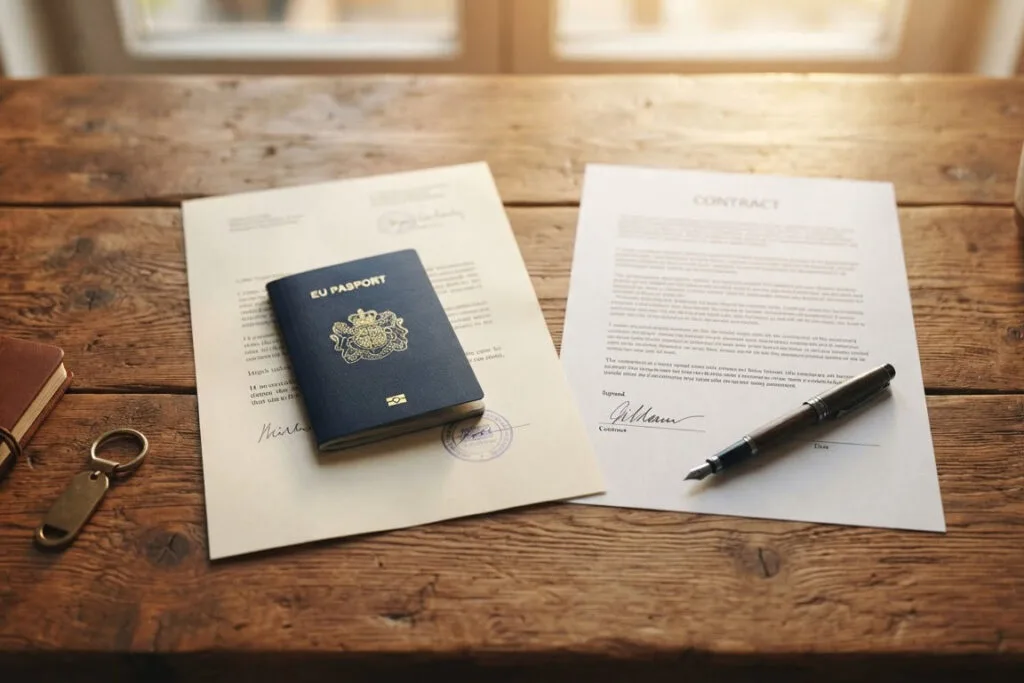
Yes, with a legal basis for residence. Since 1 January 2021 British citizens are third-country nationals in the EU: you can visit for up to 90 days in any 180-day period without a visa, but living and working in the Netherlands needs a residence permit from the Immigration and Naturalisation Service (IND). The common routes are work, family, the Withdrawal Agreement, study and self-employment.
Work. Most British professionals arrive as a highly skilled migrant (kennismigrant). Your employer must be a recognised sponsor with the IND and applies on your behalf; the salary has to meet the threshold for your age group.
Family. If your partner is Dutch or an EU citizen living in the Netherlands, you can apply as a family member. For a Dutch partner the income requirement and civic integration rules apply; for an EU partner the procedure is lighter.
Withdrawal Agreement. British citizens who already lived in the Netherlands before 2021 hold a Withdrawal Agreement residence document and keep their rights.
Study, self-employment, the orientation year. Students get a permit through their institution; founders can apply as a start-up or self-employed; recent graduates of top universities can use the orientation year.
What is the order of work before, during and after the move?
The order of work for a move from the UK to the Netherlands is: residence route and housing three months out, customs application and inventory six weeks out, access and the hand-luggage suitcase two weeks out, and registration, BSN, bank, health insurance and GP in the first two weeks after arrival.
Three months before. Secure the residence route and a signed employment contract. Start the housing search early; in Amsterdam, Utrecht and The Hague rental supply is tight. Get quotes based on a volume estimate and see how a removal to the Netherlands from the UK runs door to door.
Six weeks before. Submit the customs relief application (see below) and prepare the inventory. Book the removal date. Arrange pet paperwork with your vet. Tell HMRC that you are leaving the UK (form P85 if you have no UK tax return to file).
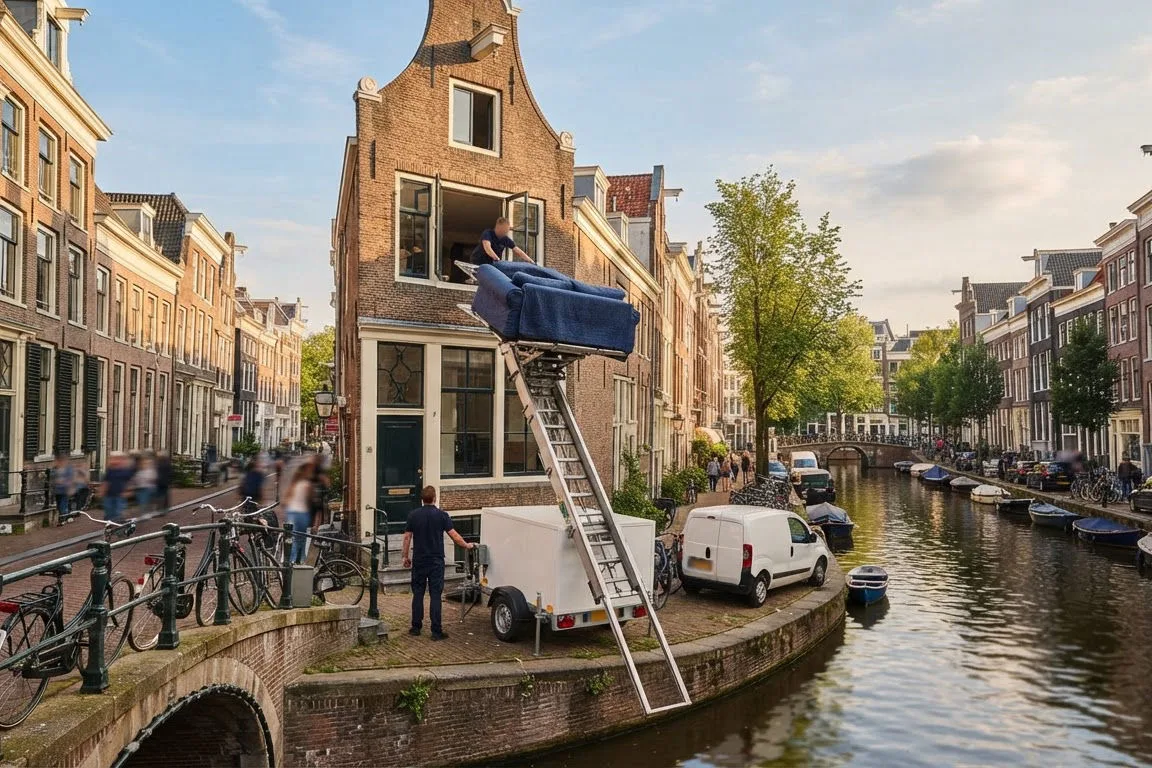
Two weeks before. Confirm access at both addresses: Dutch canal-side streets and narrow stairwells often require a moving lift and a parking permit from the municipality. Pack a suitcase with documents, medication and first-week essentials that travels with you.
How do you bring your household goods through customs into the EU?
Used household goods enter the Netherlands free of import duty and VAT under the transfer-of-residence relief, provided you lived outside the EU for at least 12 months, owned and used the goods for at least 6 months, and import them within 12 months of settling. The application goes to Dutch Customs before the shipment travels, as an import declaration (Government of the Netherlands). The relief does not cover alcohol, tobacco, commercial stock or vehicles bought for the move.
You submit proof of your previous residence in the UK (tenancy or council tax), proof of your new residence (a rental contract or a registration), your passport and a detailed inventory. Customs issues a decision that the mover attaches to the import declaration. Without it, duty and VAT become payable at the border and the vehicle waits.
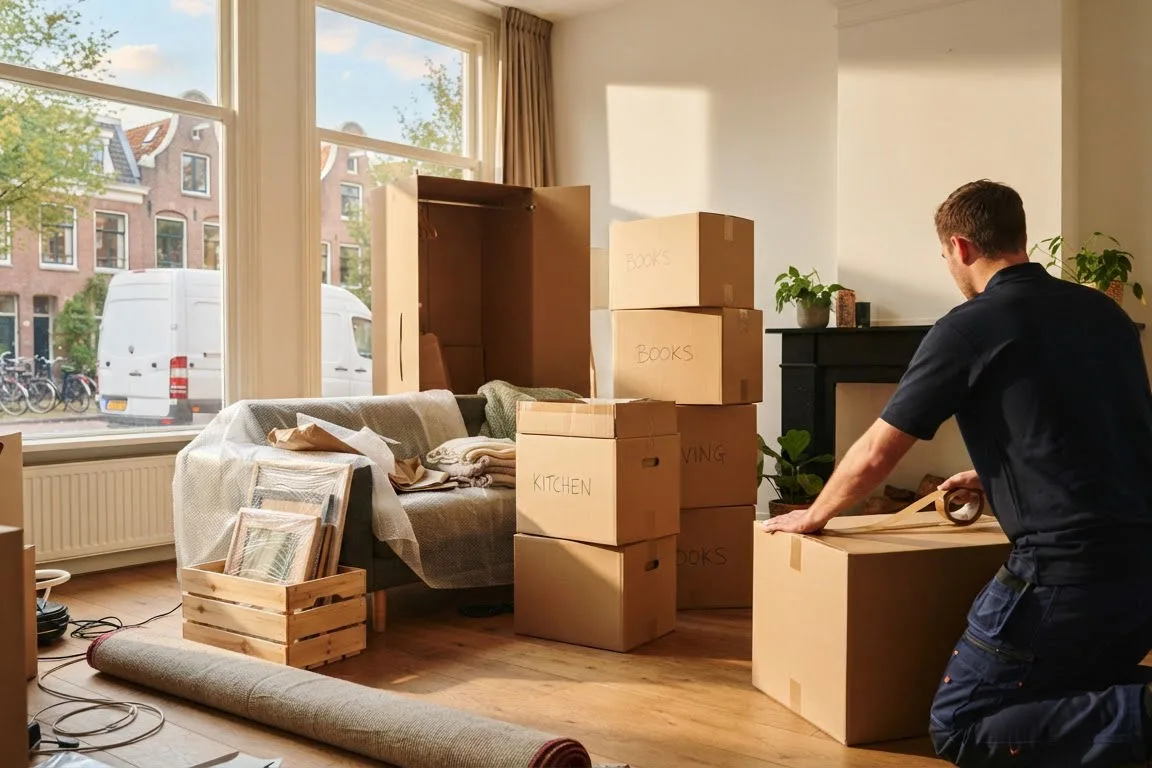
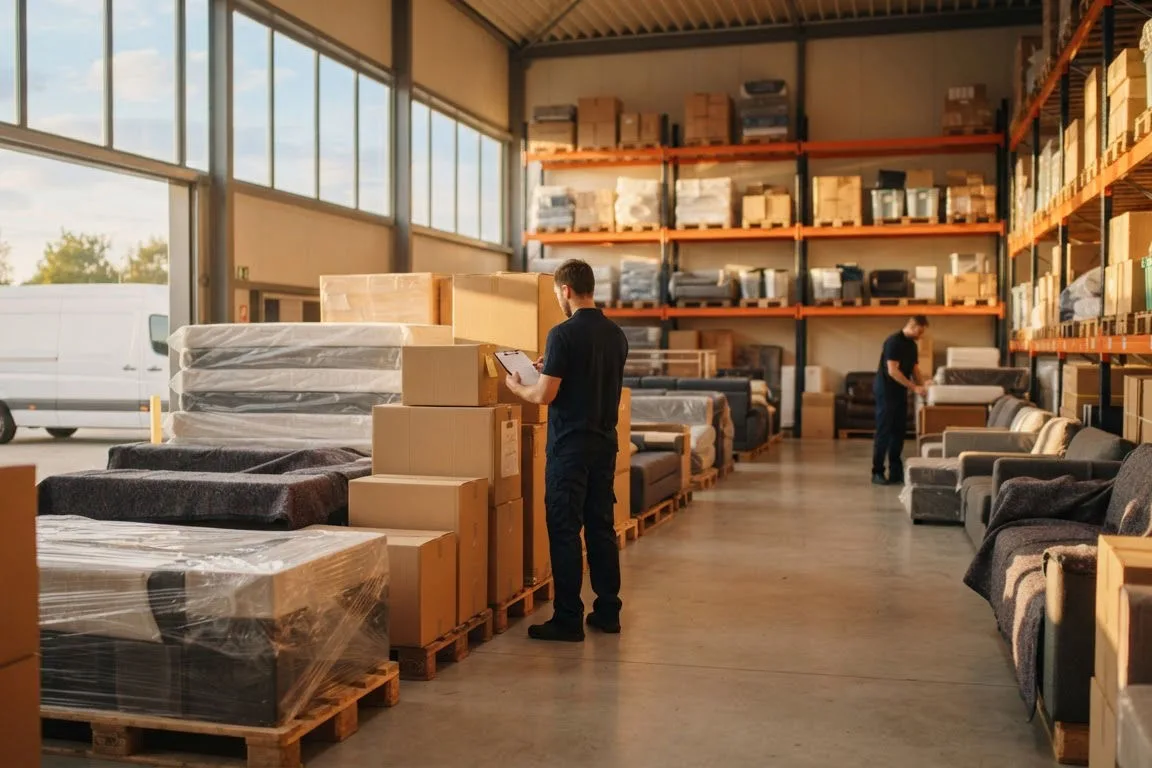
The inventory has to be itemised: “20 boxes, kitchen” is not enough, “box 12: cookware, used, 2018” is. Groupage shipments (your goods sharing a vehicle with other moves) are cheaper but fixed to the carrier’s schedule, so the customs decision must be in hand before the departure date. Our international moving service prepares the declaration as part of the move.
How do you register, get a BSN and open a bank account?
Registration in the Personal Records Database (BRP) at your municipality within 5 days of arrival is the first step after landing; the Government of the Netherlands makes it mandatory for anyone staying longer than 4 months. Registration is free and gives you the BSN, the citizen service number that every employer, insurer, bank, school and the Belastingdienst uses. Bring your passport, your residence document or the IND decision, your rental contract and, if asked, a legalised birth certificate.
DigiD. The government login. You apply online with your BSN and activate it with a letter to your Dutch address.
Bank account. Dutch banks open accounts for new residents with a BSN, a passport and proof of address. Rent, utilities and health insurance are paid by direct debit from a Dutch account, so do this in the first week.
How do health insurance and a GP work in the Netherlands?
Everyone who lives or works in the Netherlands must take out the Dutch basic health insurance (basisverzekering) within 4 months of becoming a resident, and the cover is backdated to the day your residence began. The basic policy is the same at every insurer; prices and extras differ. Lower incomes receive a monthly contribution (zorgtoeslag) through the Belastingdienst. Your UK GHIC does not replace it.
Register with a general practitioner (huisarts) near your home as soon as you have an address. GPs are the gatekeepers to specialists and hospitals, and practices in the larger cities regularly close their lists, so do not wait for a first illness. Bring a summary of your NHS record and your repeat prescriptions.
What happens to your car, your driving licence and your pets?
Your UK driving licence can be exchanged for a Dutch one without a test once you are registered, your car comes in duty-free if you have owned it for at least 6 months, and your dog or cat needs a microchip, a rabies vaccination at least 21 days old and an EU animal health certificate issued within 10 days of travel. Exchange early: the Government of the Netherlands says you avoid a retest only “if you do this in time”.
Car. A car you have owned for at least six months comes in free of import duty and of the Dutch registration tax (BPM), with proof of ownership and use. It then needs an RDW inspection, Dutch plates and Dutch insurance. A right-hand-drive car resells slowly here; weigh that against selling in the UK.
Pets. UK-issued pet passports are no longer valid for entry into the EU, so the certificate comes from an official UK vet. See our page on moving with a dog or cat.
How much does a move from the UK to the Netherlands cost?
A move from the UK to the Netherlands costs what the volume, the access and the transport mode add up to: a one-bedroom flat in groupage is a fraction of a four-bedroom house in a dedicated vehicle, and a fifth-floor walk-up at either end adds labour or a lift. Ask whether customs preparation is included or itemised. Our small move option suits single rooms and studios.
On the Dutch side, budget for one to two months’ rent as deposit (Wise, 2026), the first month’s rent, the health insurance premium from day one. Income tax is withheld by your employer; if you come as a skilled migrant, ask about the tax facility for incoming employees (the expat ruling) and check the current rate with the Belastingdienst or your employer’s adviser. For a fixed price with no hidden fees, the Easy Quote form takes a volume estimate and both addresses.
Frequently asked questions
Do UK citizens need a visa to live in the Netherlands?
You need a residence permit for any stay over 90 days in 180, and depending on the route a provisional residence permit (MVV) before travel. Your employer or your partner is usually the applicant. Short visits of up to 90 days in 180 remain visa free, which covers house-hunting trips.
Does my employer have to sponsor me?
For the work route, yes. A highly skilled migrant permit can only be applied for by an employer that is a recognised sponsor with the IND; the IND publishes a public register of recognised sponsors, so check a prospective employer before accepting. Without a sponsor the remaining routes are a partner, study, the orientation year or self-employment.
Can I use my UK bank account and card in the Netherlands?
For card payments and cash, yes, but not for daily life. Rent, utilities and the health insurer collect by direct debit from a Dutch IBAN, and many shops only accept the Dutch debit system, so a Dutch account is a first-week job. Keep the UK account open for the final UK bills and for HMRC.
Is the Netherlands expensive compared with the UK?
Rent is the difference. Wise (2026) puts average monthly rent in the Netherlands about 20% higher than in the UK, with everyday costs broadly comparable; a Reddit reply from February 2024 quotes about 1,000 euros a month for a basic one-bedroom flat in a small town.
Which cities do British expats move to?
Amsterdam, Utrecht, Rotterdam, The Hague and Eindhoven, the last one driven by the technology sector. Each has an international community and English-speaking services, and The Easy Move serves all five from its base in Eindhoven; see our local page for moving in Eindhoven.
Where do I start?
With the residence route and a registered address; everything else hangs on those two. Then the customs application, because the goods should not leave the UK before the decision is in hand. A quote based on a volume estimate then gives you a price and a date.